No place on earth could match the strangeness of the southern plains, Josie believed—despite the flatness, the naked wind, the way the land seemed to bleed your memories back out of you like sweat through an old shirt. The story of her family was written into the earth, the lines carved down from the foothills to the valley’s belly, through the long grass and the dust and the brittle trees that stood like ancient judges over the whole affair. Her father, Jacob, liked to say they had always belonged to the land, even before they had a right to. Josie half-believed him, but she also knew the land was no friend. The land was a thing to be survived. That was what everyone who outlived their own mothers and fathers learned, sooner or later.Josie’s father had come out west as a child, riding in the shadow of a wagon, the youngest of five, a little more blood and spit than hope. His mother and father had packed up their lives from a damp, moldy clapboard house in Tennessee, chasing the rumor that the world might be better if you just walked far enough. But the world was always the same, only flatter and emptier and more eager to swallow you up. In the time it took for the wagon to cross the divide, the family lost nearly everything. Josie’s father watched as his oldest brother, clever and strong, took a rattlesnake’s bite while relieving himself by a dry creekbed. He died in a day, swelling until his skin split like overripe fruit, and the grave was shallow because the ground was hard. The next brother, who could recite whole psalms by heart, drowned in a flash flood that swept through the gully in the night—a wall of water that left nothing behind but the smell of wet, uprooted grass and a single, sodden boot. The third child, a sister, fell to fever. Nobody knew what kind, only that her skin grew hot, her teeth clenched, and she stopped speaking after three days. Their mother wrapped her up with extra care before digging the grave, and for a week afterward she kept the little girl’s shoes tied tight to the back of the wagon, as if some part of her might be left to reclaim.The last sibling, a boy with pale eyes and a habit of whistling under his breath, made it all the way to the valley only to starve. There was food, but he would not eat. He sat with his back against the wagon wheel, staring at the horizon, and wasted down to nothing until he simply went to sleep and didn’t wake. Josie’s father never spoke much of him; she only learned the story in pieces, supplied by old neighbors with bad teeth who remembered the family’s arrival. By then, Jacob was the only child left, and his mother—Josie’s grandmother—was already old before her time, her skin sunbaked and her hands knotted like driftwood.When the family found their patch of land, Jacob was just eleven, already taller than his mother, already old enough to know how to build a fence and drive a nail straight. They pitched their tent under the only tree within sight—a stubborn, sprawling oak whose roots spread wide and shallow, thirsting for water that was never there. For a while, they spoke of building a house, but that dream fell apart as surely as the wagon’s wheels, and eventually they made do with a lean-to, tarps stretched over poles, whatever they could scavenge from what little remained. In the end, even the covering was not enough for Josie’s grandmother. She took pneumonia in the first cold snap and died a month before Christmas, her breath turning to frost before vanishing into the dark. There was no coffin, not even a proper shroud; they wrapped her in her own quilt and buried her beneath the oak, the ground stinging their fingers with frost as they dug. When the wind blew, the branches creaked and groaned, and the sound, Jacob claimed, was the voice of his mother, telling him to keep moving, not to linger or look back.These stories Josie knew not as ancient history, but as the raw flesh of her own life. Her father repeated them the way other men repeated scripture, always with a warning woven in. The land owed you nothing. The land was waiting, always, to take back what little you built on it. Loss came quickly out here, and it stuck to a family like a bad smell. Josie herself was born already missing a piece—a mother who died before she could make sense of the world, a father who was equal parts stone and sorrow, and three brothers whose idea of tenderness was a hard shove or the sharp end of a joke. Childhood, for Josie, was not a thing to be cherished, but a thing to be endured, like drought or the plague of grasshoppers that sometimes blackened the sky.She was the youngest, by a long shot. Her brothers—Henry the eldest, Robert in the middle, then Beau—formed a closed unit that barely tolerated her presence. Their mother had survived their births with nothing more than a few extra lines on her face, but when Josie came, the fourth and final, her mother’s body simply gave up. Nobody told Josie that directly, but she heard it enough in the way Henry spat her name, the way Robert made a face when she walked into a room, the way Beau sometimes hunched his shoulders and muttered, “Would’ve been better if you’d stayed in the ground.” The first time her father heard one of the boys say it, he cracked a wooden spoon over Henry’s back. But he never spoke a word of comfort to Josie, never took her aside to tell her it wasn’t her fault. He believed, she suspected, that it was.If she wanted to see her mother’s face, all Josie could do was climb the ladder to her father’s room—off-limits in theory, but never locked—and root through the battered trunk at the foot of his bed. There she found the photographs, stiff and sepia, the paper curling at the edges from time and sweat. Some were of her mother as a child, ribbon in her hair, standing next to a cow with a stubborn, flat stare. Others showed her parents together, young and unsmiling, his hand on her wrist as if to keep her from drifting away. There were no photographs of Josie’s birth, only a gap in the sequence, and then images of her father alone, older, the lines in his face etched deeper.She studied the photos as if she might piece together a memory from their fragments, but the woman on the paper never changed, no matter how fiercely Josie willed her to move, to speak, to reach out and touch her cheek. She would sit for hours at the foot of her father’s bed, knees bunched under her chin, the sound of the house quiet and strange in her ears. Sometimes, if she was very still, she imagined she could hear the woman’s voice, not as words, just as the hush that followed a question, or the warmth at the end of a lullaby.Instead of a mother’s guidance, Josie grew up with her brothers’ rough tutelage. Robert taught her how to brace a shotgun against her shoulder—her first time, the butt kicked up and bloodied her lip, and he laughed so hard he fell off the fence rail. Beau showed her how to braid leather into a lasso, how to tie knots that would never slip. Henry, sullen and restless, mostly ignored her, except when he needed an extra pair of hands or someone to bully into silence. They were wild boys, never content to stay inside, forever running off into the brush, coming back with torn shirts and bloody knuckles and stories too mangled to believe. Josie learned to follow them, learned to keep up. She rode bareback, climbed trees, spit tobacco juice when dared. She learned to fight like a boy, take a punch and not cry, and return it twice as hard.But every evening, her father expected her to sit at the table with her hair clean, her dress unsoiled, her hands folded neatly in her lap. The contradiction was never spoken, only lived: Josie among the boys, dirty and wild, then Josie the girl, quiet and proper, her father’s idea of what her mother would have wanted. She hated it, but she learned to switch between selves as quick as changing a hat. By sixteen, she could start a fire from wet wood, shoot the tip off a fence post from a hundred yards, and also mend a torn sleeve or pluck a chicken in record time. Her father called her “perfect,” but even as he said it, his eyes went distant, as if he was praising not Josie, but the ghost of her mother.The mornings were still her own, though. Josie alone, before sunrise, in the small square of room that had once been a pantry. She cherished the moments when the boys were still tangled in sleep, the house silent except for the ticking of the kitchen clock and the distant murmur of wind through the long grass. She liked the chill in the air, the way the world outside the window seemed suspended in the fog, blue and gray and untouchable. Then she would rise, pick her way across the boards so as not to wake anyone, and begin her day.On the morning that changed everything, Josie woke at five. The dream she’d been having—her mother’s hands, soft and damp, plaiting her hair—faded the instant her feet hit the the rough wooden floor.The morning rituals had become mechanical—a series of practiced gestures, carried out with a kind of delicate ferocity. Josie would rise, shake off the residue of her dreams, and glide through her routines before the world could catch up to her. Each day she became a little more efficient, almost ruthless, in the enterprise of putting herself together: hair brushed and plaited, twisted into a thick, practical bun at the nape of her neck, bound tight with a faded blue ribbon that had once belonged to her mother; teeth cleaned with salt and old ash, the taste sharp and strangely comforting. She scrubbed her face with water from the rain barrel out back. The cold made her cheeks bloom pink, and she liked the feeling of being alive, of existing fully in her own skin, if only for these brief, silent minutes before the house woke.She dressed with care, but not out of vanity. Rather, it was a kind of armor: a thin, cream-colored dress, hemmed just below her knees so she could run if she needed to, sleeves rolled up to the elbows, collar buttoned modestly. There was a time she would have worn her mother’s brooch pinned to her breast, but she’d lost it in the woods the summer before, and after searching for weeks, she’d stopped looking. The loss stung less with each passing morning, until the memory of it became almost pleasant, a small ache she could return to at will. Over the dress went a battered muslin apron. She fastened it tight around her waist, then slipped her feet into the old boots by the door—her mother’s boots, too large by half a size, repaired so many times that the patchwork soles looked like a map of strange and distant countries.The kitchen was her domain. That was understood, if never spoken aloud. She’d learned to cook by watching her father, then by doing, by failing, and by stubborn repetition. This morning, she set a pot of water to boil on the woodburning stove, the coals still hot from the night before. She measured out the grits with the stub of a wooden spoon, pinched salt and black pepper between her fingers. It was a small act of rebellion, the way she seasoned the food for herself first, always tasting it before anyone else. As the pot steamed and burbled, she broke a half-dozen eggs into a bowl, stirring them with brisk, rhythmic strokes, then sliced bread from the hard, dark loaf that her father insisted upon, saying it kept a man full through a day’s labor.Nobody else was awake, or if they were, they pretended not to be. Josie treasured this time, the hush of the world before the violence of day, the air in the kitchen sweetened by yeast and the faint, metallic tang of the stove. She worked in silence, letting her mind wander. Sometimes she imagined a different life, one where the horizon was not a threat but a promise, where she might read a book for pleasure, lie in bed until the sun was high, or listen to her mother sing as she mended clothes by the fire. More often, she imagined nothing at all.From time to time, she moved back and forth between the window and the stovetop, checking the progress of the sunrise as much as the food. The window above the sink was warped, its view of the plains slightly tilted, but that only made the world outside seem more real, more urgent. She watched as the prairie, first a dull blue, then silver, then gold, trembled with early light. The wind was already up, bending the tall grass, sending ripples through the fields like water. Josie found herself scanning the far edge of the horizon, not looking for anything in particular, but unable to help herself. Sometimes, if she stared long enough, she would see movement—a rabbit, a hawk, a neighbor’s stray cow—but this morning the grass was empty. She pressed her forehead to the cool windowpane, feeling a strange weight in her chest.The house itself was a living thing, groaning and settling around her. She listened to the familiar sounds: the creak of floorboards, the sigh of rafters, the soft patter of mice in the walls. The boys slept on, tangled together like puppies in the loft above the kitchen, only occasionally snorting or kicking out in their sleep. Her father’s room was at the far end of the house, behind a sliding door that stuck in the tracks when the humidity was high. Josie could hear, faintly, the rise and fall of his breathing. It comforted her, and it didn’t.She finished the grits, set the eggs to scramble in a skillet slick with bacon grease, then opened the window to let the air in. The breeze carried the scents of wild sage and dust, and Josie inhaled deeply, tasting the morning. For a moment, she closed her eyes. She tried to imagine her mother’s voice, the exact timbre of it—the way it might have sounded when she called Josie’s name, or the lullabies she must have sung, or the curses she might have muttered under her breath when the bread burned or the boys tracked mud through the house. All Josie could conjure was a blur, a warmth at the edge of memory, and she found herself wishing, not for the first time, that ghosts could visit in daylight.A crash from the boys’ loft brought her back to herself. She heard Robert grumbling, Beau laughing, Henry’s impatient bark. The noise meant the day was beginning, that she would soon be needed, and the knowledge filled her with both purpose and dread. She set the table for five, just as always, lining up the tin cups and chipped plates, folding napkins from flour sacks. There was a ritual to this, too, and she followed it religiously, never once missing a setting. Not even after her mother died, not even after every meal became a silent sermon about loss and the futility of hope.She was ladling grits into bowls when she heard the first unfamiliar sound—a low, distant thunder, like the approach of a summer storm. But there were no clouds, and the air was dry as bone. Josie stilled, spoon held midair, her senses sharpening. The sound grew louder, separating into distinct beats, then into the unmistakable cadence of hooves. Four, five, maybe six horses, moving fast, not in the lazy canter of a neighbor’s visit, but in the tight, pounding rhythm of pursuit.Josie felt a cold shiver run from her scalp to the soles of her feet. She set the spoon in the pot and wiped her hands on her apron, instinctively moving to the window for a better view. The horses were closer now, the hooves kicking up plumes of dust, riders hunched low in the saddle. They were strangers—she could tell by the way they rode, by the dark coats and the glint of metal at their belts, by the way they held together as a unit, as if rehearsed.She watched, paralyzed, as the figures drew nearer, then rounded the bend and fanned out in front of the house. A single, sickening moment of stillness, and then chaos: one of the men dismounted, raised a rifle, and fired a shot into the air. The sound cracked the morning open. The rest happened in a blur—her father’s door slamming open, his voice bellowing her name, the boys tumbling down the ladder, half-dressed and wild-eyed, Beau already reaching for the hatchet he kept under his pillow.Josie didn’t think. She moved, as if puppeted by something older than herself, darting to the pantry and yanking open the cabinet where the shotgun was meant to be, only to find it empty, the shelf lined with nothing but dust and the vague scent of gun oil. She cursed, then grabbed the closest weapon at hand—
a heavy iron skillet, slick with bacon grease and still radiating heat. She gripped it in both hands, knuckles white, and sprinted to the front of the house.She arrived just in time to see her father standing on the threshold, the boys flanking him, their faces set with terror and something uglier: the certainty of death. Josie felt herself shrinking, as if observing from a great distance. The men outside were shouting now, their voices thick and slurred, the words lost to the wind. She caught only fragments: “hand over,” “no trouble,” “burn it down.” Her father raised his own voice in reply, but she could not hear him. Her ears were filled with a ringing, a high, keening whine that obliterated all else.The first bullet hit the porch post, splintering wood and sending shards flying. The second found her father, just above the heart. He staggered, then crumpled without a sound, falling backward into the arms of Henry, who screamed, “No!” with such raw force that Josie felt it vibrate through her bones. Robert lunged forward, swinging the old rifle like a club, but the man on the porch was faster—he caught Robert by the throat, lifted him off the ground, then slammed his head into the doorframe. The boy went limp, folding at the knees.Beau made it two steps before another shot rang out. He spun, arms pinwheeling, and hit the floor hard, blood already pooling under his shirt. The air was thick with cordite and dust, the stink of death instantaneous and absolute. Josie screamed, the kind of scream she’d always pictured erupting from other people, people in stories who found themselves suddenly at the mercy of men with guns and no patience. The sound ripped from her chest with a violence that surprised her, louder and higher than anything she’d ever let herself make before, and for an instant it stunned even the men outside. The one with the rifle glanced up, his face a mask of disgust, but the others laughed, a harsh chorus that seemed to welcome her terror as part of the morning’s entertainment.She froze, skillet still in her hands, as if the act of screaming had drained all the fight from her. Her eyes darted from the blood blooming through Beau’s shirt to the slack, twisted shape of Robert at the door. Henry was sobbing uncontrollably, his hands slick with their father’s blood, trying and failing to piece the wound together as if it were a bad patch in a flour sack. The world narrowed and tunneled until all she could see was the silver barrel of the rifle, the finger tightening around the trigger, the black hole at its tip growing and growing until it blotted out the room.A hand grabbed her by the braid and yanked her backwards, hard enough to send the skillet clattering to the floor. She didn’t see who it was until she landed, knees scraping raw against the floorboards, nose filled with the iron tang of blood and stove smoke. Her vision swam but she recognized the man by his boots—black, shiny, too new for anyone around for miles. He hauled her upright and shoved her toward the porch, where the other men waited. She thrashed once, trying to bite, but a fist found her stomach and emptied her lungs. She doubled over, retching.“Hold her,” barked the man with the rifle, who’d already re-chambered a round. In the corner of her vision Josie saw Henry scrambling to his feet, face white with grief and rage, both hands gripping a splintered table leg. He charged the nearest man, but before he could close the gap, the butt of a pistol cracked against his temple with a sickening thud. Henry dropped soundlessly, limbs askew.For a moment, the morning stilled again, the only noise Josie’s own ragged breath and the distant, flutelike trill of a meadowlark beyond the broken window. She felt the world slipping away, the edges of her vision going gray, but she forced herself to stay upright. She wanted to say something, anything, but the words stuck and burned in her throat.One of the men—older, with a mustache yellowed by tobacco—grabbed her by the jaw and turned her face toward him. “You listen now, girl,” he said, voice low and oiled with contempt. “You keep quiet, and maybe we got no quarrel with you.” Behind him, the men fanned out into the kitchen, tearing open cupboards and tossing jars, their laughter and cursing crashing through the room like a second, cruel wind.She stared past the man’s shoulder, beyond the porch, into the unbroken gold of the morning. She could see nothing but grass, swaying gently as if nothing at all had happened here.The last thing she saw was the butt of the rifle, swinging in a vicious arc toward her temple.
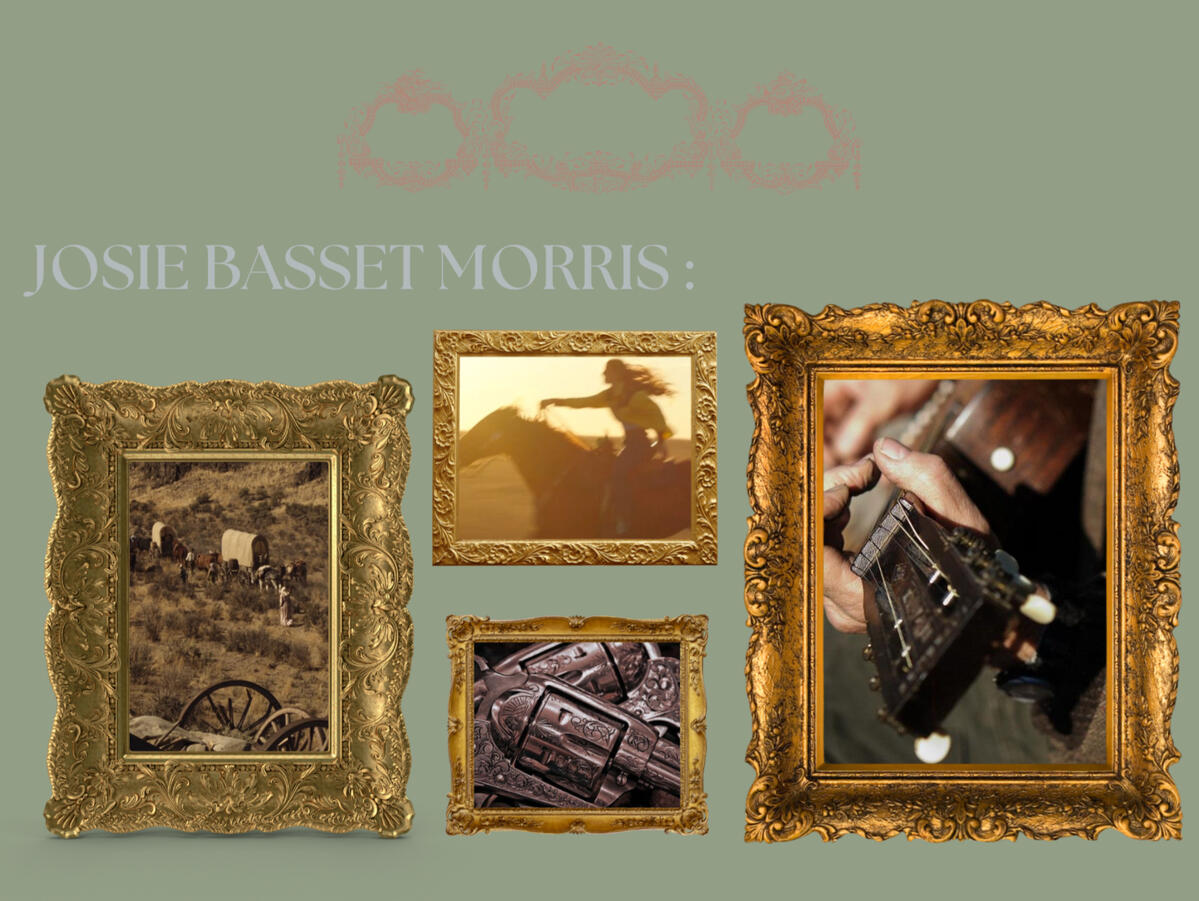
Josie stands tall enough that most men find themselves recalibrating when she enters a room. Her hair is the first thing they notice—an unruly cascade of deep orange that seems to generate its own light, falling past her shoulders in waves she has long since stopped trying to tame. Her skin is the kind of pale that burns in June and glows in December, dusted across the nose and cheeks with freckles that cluster like constellations.
Her jaw is sharp enough to cut glass, softened only by the dimples that carve into her cheeks when she smirks, which she does often and always on purpose. Her eyes are olive green with a dark ring at the edge of each iris, the effect being that she always looks like she knows something you don't.She grew up shooting cans off fence posts in the Carolina heat and has never once apologized for anything she meant to do. She is the kind of woman who reads a room the moment she walks into it and has already decided what she wants from everyone in it before they've finished deciding what to make of her. The people she loves, she loves like a riptide—quietly, powerfully, and in a way that is very difficult to swim out of. Josie cuts a figure you don't forget—tall enough to meet most men at eye level, with the kind of build that looks equally at home in a saddle or a Sunday dress. Her hair is the first thing people notice, a tangle of deep orange that seems to resist any attempt at order, spilling down her back in waves that catch light like copper wire. Her face has an edge to it: a jaw that could have been cut from flint, cheekbones that sit high and easy, and dimples that show up uninvited whenever she's amused by something—which is often.The freckles scattered across her nose and cheeks are the only soft thing about her face at first glance. Her mouth is full, the upper lip arching into a pronounced cupid's bow that makes her expressions hard to read—a smile can look like a warning. Her eyes are olive green shot through with brown at the outer rim, the kind of eyes that make you feel like you're being sized up even when she's only half paying attention.She grew up Southern and it shows—not in sweetness, but in the particular confidence of someone who learned early how to get what she wanted and never saw a reason to stop. She can talk her way into a room and shoot her way out of one. The charm is real, but it's a tool. The loyalty underneath it is the part she doesn't advertise.